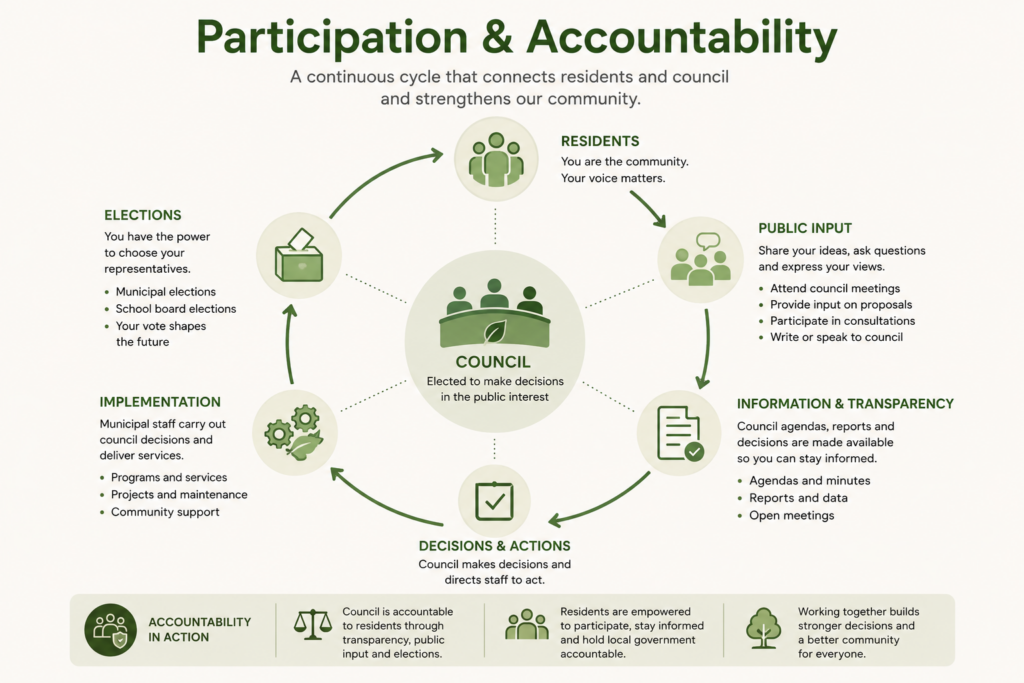
How Residents Engage With Municipal Government and How Input Is Used
This page explains how residents interact with municipal government in Ontario and how public input is typically incorporated into decision-making.
It focuses on formal participation channels and accountability structures within municipal systems.
For background on how municipal government is structured, see:
How Local Government Works
For context on proposed structural changes, see:
Bill 100 Explained
How Residents Participate in Municipal Government
Residents can engage with municipal government in several formal ways.
Common methods include:
- attending municipal council meetings
- reviewing public agendas and reports
- speaking at public meetings or hearings (delegations)
- submitting comments or written feedback
- contacting elected officials directly
- voting in municipal elections
These are established channels within the current municipal system.
How Public Input Is Used
Public input is considered at different stages of the decision-making process.
In general:
- some input is collected before decisions are made
- some input is reviewed during formal council processes
- some input is submitted during public consultations or hearings
- final decisions are made through council votes
Not all input has the same timing or impact, depending on where it occurs in the process.
When Participation Typically Has Influence
Public input tends to have the most influence when it is:
- submitted early in the decision process
- connected to specific agenda items or proposals
- part of formal consultation periods
- presented during committee or review stages
Once decisions reach final approval stages, options are often more limited.
How Accountability Works in Municipal Government
Accountability in municipal government refers to how elected officials are answerable to residents.
This typically includes:
- municipal elections
- public council meetings
- published agendas and meeting minutes
- recorded votes and official reports
- public questions and delegations
These mechanisms are designed to make decision-making visible and traceable.
What Accountability Looks Like in Practice
In practice, accountability operates through a combination of:
- electoral cycles (voting for representatives)
- transparency (public access to decisions and records)
- direct engagement (contacting councillors or speaking at meetings)
Together, these create a system where residents can observe and respond to decisions.
Limits of Participation
Participation is structured through formal processes.
This means:
- not all input leads to changes in outcomes
- timing affects how input is considered
- some decisions are constrained by legal or procedural requirements
- final authority rests with elected councils
Understanding these limits helps clarify how the system functions.
Key Concepts
Participation
The ways residents engage with municipal government, including formal and informal input channels.
Accountability
The process by which elected officials are answerable to residents through elections, transparency, and public process.
Decision timing
The stage in the decision-making process where input is received and how that timing affects influence.
Related Questions
These are common system questions related to participation and accountability:
- When does public input have the most influence?
- How are resident concerns incorporated into decisions?
- What mechanisms ensure accountability in local government?
- How do residents interact with elected officials?
- What limits exist in formal participation processes?
These questions describe how the system operates.
Related Pages
This page is part of a broader set of municipal governance resources.
- How Local Government Works
Overview of municipal councils, staff roles, and decision processes. - Bill 100 Explained
Structural overview of proposed changes to municipal governance.